
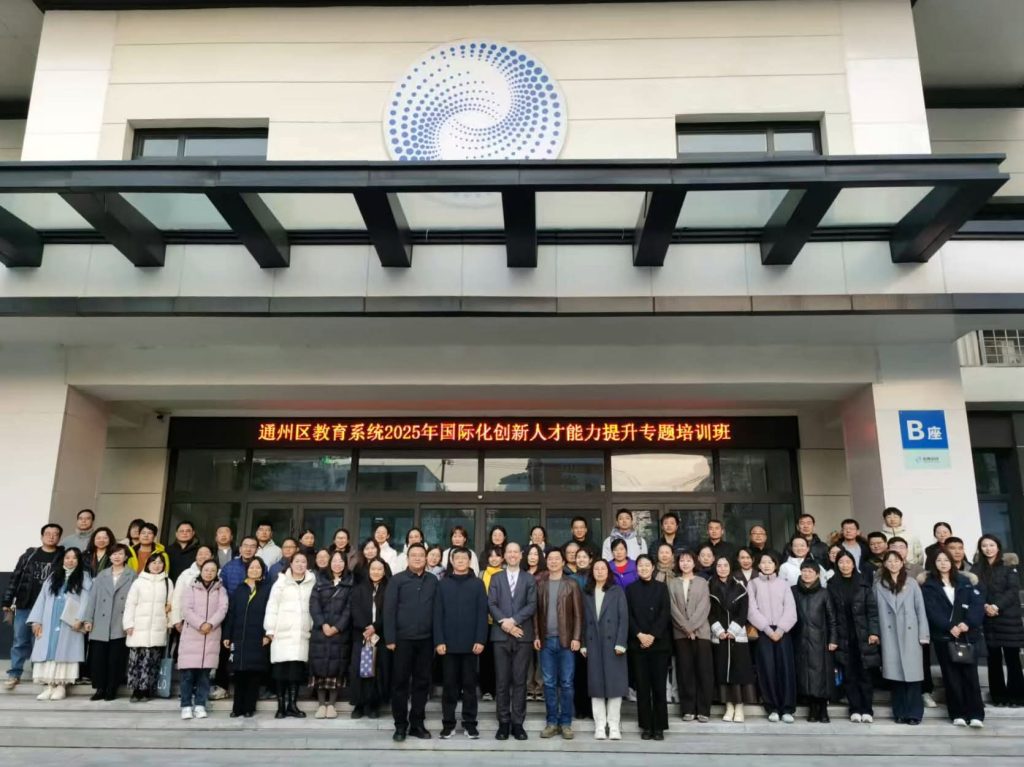
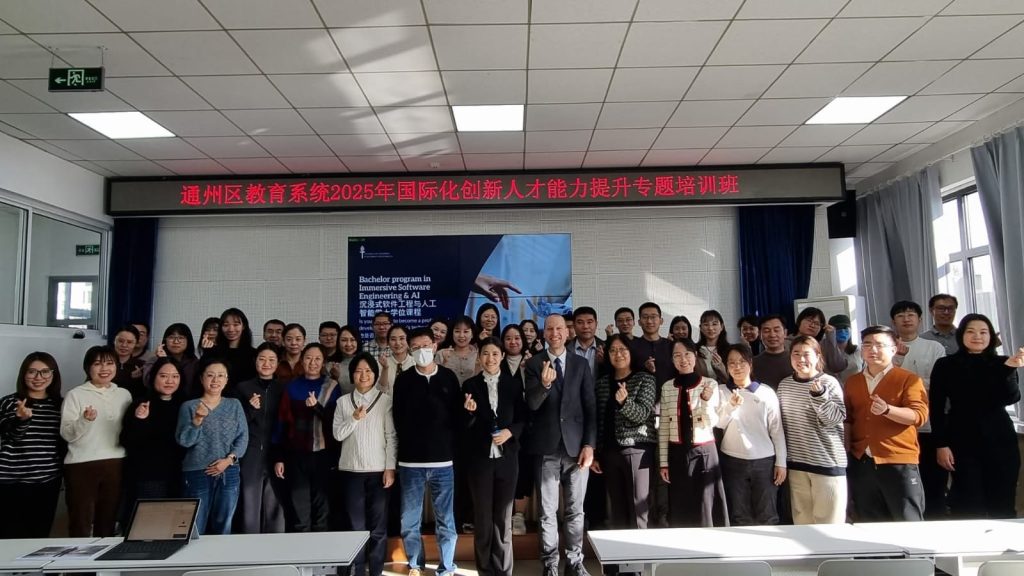
Our STEAM Director, Dr. Kristof Fenyvesi, recently returned from Beijing, where he led a one-week intensive programme on AI in education for 100 teachers from some of the city’s leading primary and secondary schools. Rather than isolated pilot projects or experimental future classrooms, the visit revealed a coordinated and systemic transformation already taking place across one of the world’s largest school systems.
The scale is difficult to grasp. Beijing alone has around 1.6 million K-12 students, roughly 100,000 teachers, and about 1,500 primary and secondary schools, many of which have already introduced structured AI classes. Across mainland China, the numbers reach approximately 230 million school students, 18 million teachers, and 200,000 schools. When policymakers speak of giving every student access to AI literacy by 2030, they are describing the largest education redesign in human history. Based on what Dr. Fenyvesi observed, that timeline may arrive sooner than expected.
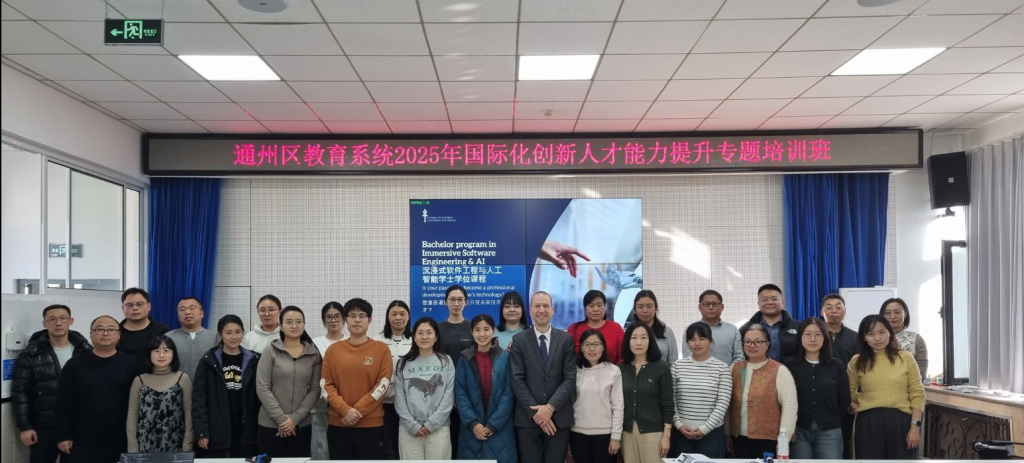
Teachers in the programme were not simply using AI to automate tasks. They applied it to interdisciplinary inquiry, STEAM integration, sustainability analysis, creative storytelling, problem-based learning, and futures thinking. Several teachers showed how AI helped students analyse climate data, design low-carbon futures, model ecosystems, and explore ethical dilemmas. AI was treated as a cognitive and creative partner rather than a shortcut.
In the first half of 2025, China’s generative AI user base more than doubled, reaching 515 million users. For students, AI is becoming a normal part of learning rather than an exotic add-on. The ecosystem is coordinated across national strategies, municipal execution, teacher training institutes, tech providers, and research networks. This level of alignment allows rapid scale-up and offers researchers a rare living laboratory for observing how AI becomes embedded in learning cultures.
Such scale also raises critical questions. The transformation depends on a vast technological infrastructure. Data centre electricity demand is projected to grow by 165 percent by 2030, with AI as the main driver. Some AI campuses already draw more than 100 megawatts, and gigawatt-level sites are under development. Cooling requires enormous volumes of water, and hardware turnover produces significant electronic waste. Dr. Fenyvesi observed strong energy-saving practices and strict campus-wide conservation protocols, but a central paradox remains. Can AI enlarge human capability without enlarging its environmental footprint beyond sustainability thresholds?
China’s AI rollout is structured, planned, and institutionally orchestrated, a model distinct from the more fragmented, bottom-up adoption seen in the West. This enables speed, but it also raises questions about data and cyber governance, privacy, educational equity, and long-term societal effects. The key is neither to romanticize nor dismiss what is happening, but to study and understand it at scale.
This strategy offers insight into the future of global schooling. What happens when AI literacy begins at age six? When tens of millions of students learn with AI every week? When teacher training for AI becomes a national priority? During the week, Dr. Fenyvesi also gathered data using the AIWARE framework.
Would you like to participate in a similar educational tour?
info@experienceworkshop.org
+358452560420
